
Philippines ranks 53rd in World Bank business report, ARTA cites slow processing
At a regional rollout in Davao City, the Anti-Red Tape Authority said the country's stronger rules have yet to translate into faster transactions for businesses.
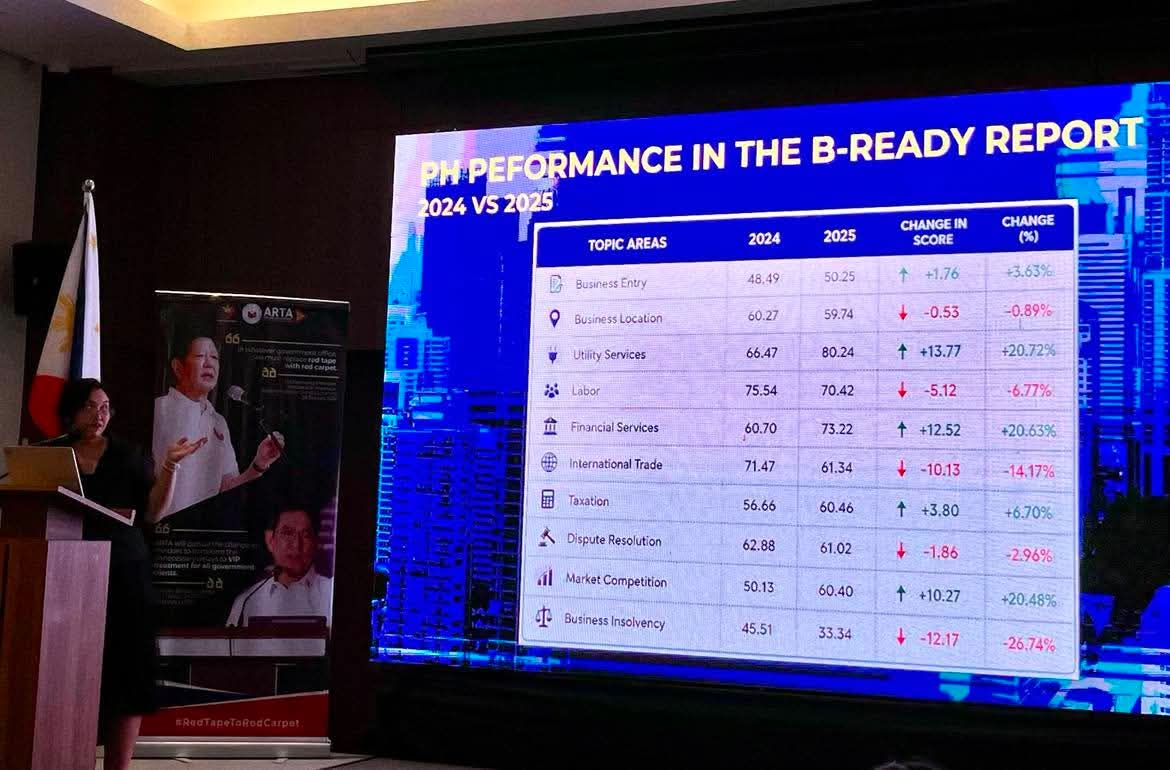
The Philippines has improved its business regulations but still lags in how quickly and cheaply firms can complete government transactions, the Anti-Red Tape Authority (ARTA) said during the first regional rollout of the World Bank Group's 2025 Business Ready (B-Ready) report in Davao City on Nov. 5, according to Mindanao Times.
Karizza Mae P. Paredes, assistant division chief of ARTA's BRO-Doing Business Division, said the country placed 53rd of 101 economies with an overall score of 61.04 out of 100. B-Ready is the World Bank Group's main tool for assessing business environments. It covers ten topic areas across a firm's lifecycle, from entry and location to utility connections and insolvency, and rates them under three pillars: regulatory framework, public services and operational efficiency.
The regulatory framework pillar scored highest at 73.86, about three points higher than in the first report in 2024, ranking 26th. ARTA credited new laws such as the National Government Procurement Act and the e-Governance Act. The agency said the World Bank noted that local business permit processing for foreign firms dropped from 103 days in 2024 to 75 days in 2025.
Public services scored 57.82, ranking 51st, a slight gain attributed to better digital systems and the publication of gender-sensitive data. Operational efficiency, which measures the time, effort and cost businesses face, declined and ranked 80th. "This is due to reported delays and processing bottlenecks experienced by private sector firms," Paredes said.
By topic area, utility services posted the largest gain, rising from 66.47 to 80.24, followed by financial services, market competition, taxation and business entry. Five areas declined, with business insolvency falling the most, from 45.51 to 33.34. International trade, labor, dispute resolution and business location also slipped.
Paredes said local government units play the main role in business entry, location, utility services and taxation, where permits and clearances are issued locally. She cited implementation gaps, limited interoperability of government systems, and limited publication of performance and sex-disaggregated data as key challenges. ARTA noted that the World Bank assesses processes end to end, so delays at agencies such as the Bureau of Internal Revenue or social security offices affect results even when local permits are issued quickly.
Paredes said the way forward includes keeping requirements clear and proportionate, making services accessible, and cutting unnecessary steps. "A good regulation must also work well at the service counter and online," she said.
Why it matters for Davao
ARTA said local governments handle key permits and clearances measured by the report, so how efficiently offices in places like Davao City process transactions, and how well their systems connect with national agencies, affects the country's business rating.
This article was written by the DavaoNews desk with AI assistance, using reporting by Mindanao Times. Facts come from the original report, which we credit and link below. Our editorial policy
Discussion (0)
Sign in with Google to join the discussion.
Sign in to commentNo comments yet. Start the conversation.