
Alibaba releases Qwen4-Max, its largest Qwen AI model to date
The Chinese tech firm says the new model handles coding, workplace tasks and scientific research at lower cost than its predecessor, Mindanao Times reported.
Alibaba has launched Qwen4-Max, which it describes as the most capable model in its Qwen family of artificial intelligence systems, according to a report carried by Mindanao Times.
The company said the model has 2.4 trillion total parameters, built-in vision capabilities and a context window of one million tokens. It uses a sparse Mixture-of-Experts design that activates only 71 billion parameters per token. Alibaba said this is 25 percent fewer than its predecessor, Qwen3.8-Max, at the same overall scale, which lowers the cost of running the model.
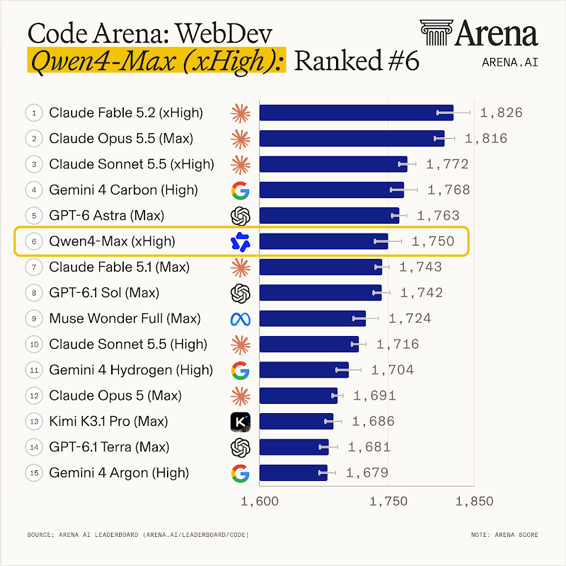
On benchmarks, Alibaba said Qwen4-Max placed 6th on Code Arena, a coding leaderboard. It also reported strong results on tests of agent workflows, workplace productivity and visual reasoning. On Work360, the company's own benchmark covering 721 specialised fields, Alibaba said the new model beat Qwen3.8-Max overall. It said the model used 35 percent fewer tokens in high-effort reasoning mode and cut the average cost per task by about 60 percent.
Alibaba also described several demonstrations. In an automotive manufacturing showcase, it said manual workpiece programming time fell from about 475 minutes to 24 minutes. In a chip-cooling project, the model ran continuously for 48 hours and identified a coolant molecule that was later validated in experiments. In an Alzheimer's research test, it designed and optimised 24 candidate molecules.
The model is now available through Alibaba's QwenCloud platform via its Token Plan and API, as well as on QwenWork and QwenStudio. Input with an implicit cache hit is priced at US$0.075 per million tokens. The company said smaller, open-weight models in the Qwen4 series will be released to developers worldwide soon.
On safety, Alibaba said it included code security checks during training. It also said it filtered cybersecurity training data to keep defensive material and remove offensive attack content. In addition, it said it added safeguards against chemical, biological, radiological and nuclear risks.
This article was written by the DavaoNews desk with AI assistance, using reporting by Mindanao Times. Facts come from the original report, which we credit and link below. Our editorial policy
Discussion (0)
Sign in with Google to join the discussion.
Sign in to commentNo comments yet. Start the conversation.